

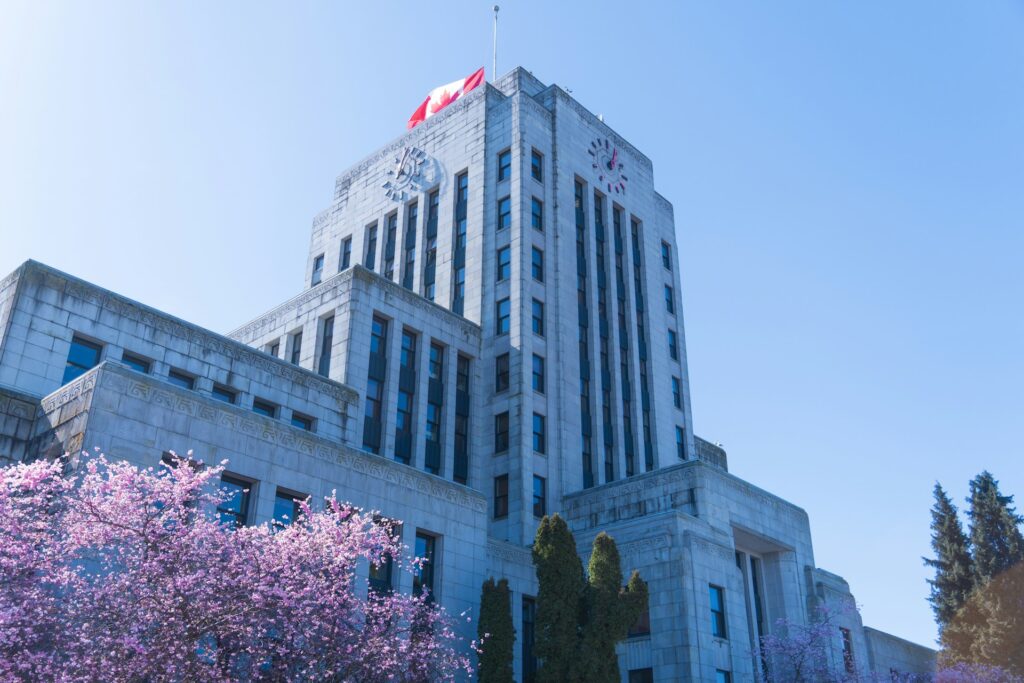
Vancouver heads to the polls on Saturday, October 17, 2026, to elect a mayor, 10 city councillors, 7 Park Board commissioners, and 9 School Board trustees — plus decide on three Capital Plan borrowing questions and two plebiscite questions. If you live in Vancouver and have never voted in a civic election before, or just want a refresher on who is running and what they actually stand for, this guide walks through everything, starting from zero.
Why this election matters
Vancouver’s mayor and council control roughly a third of the average homeowner’s property tax bill, along with zoning and housing approvals, policing budgets, road and sidewalk maintenance, and municipal water and utilities. The Park Board runs the city’s parks, community centres, and pools. The School Board runs public education for the city’s students. These are the government bodies with the most direct, daily impact on life in Vancouver, and historically the ones with the lowest voter turnout of any level of government.
First, the basics: how Vancouver elections work
Vancouver uses an at-large plurality voting system. Rather than dividing the city into wards or districts, every voter chooses from the same citywide ballot for each office, and the candidates with the most votes win the available seats — regardless of party. For council, you can vote for up to 10 candidates, and the top 10 vote-getters across the whole city win. The same applies to the 7 Park Board seats and 9 School Board seats. Only the mayor’s race is single-winner.
This matters for how you should approach the ballot: you are not picking one local representative the way you might for a provincial riding. You are building a slate of up to 21 names from whichever mix of candidates and parties you trust most, and no single vote is “wasted” the way it can be in a first-past-the-post district race.
Key dates
| Date | What happens |
|---|---|
| September 1–11 | Candidate nomination period |
| September 18, 5pm | Random ballot draw sets candidate order on the ballot |
| October 3, 7, 10, 13 | Advance voting days |
| October 5, noon | Deadline to request a vote-by-mail package by mail |
| October 17 | Election day — voting places open 8am to 8pm |
Vote-by-mail ballots must be returned by 8pm on October 17. If you plan to vote by mail, apply early, especially if you will be away from Vancouver closer to the election.
Who can vote
To vote in the 2026 Vancouver election, you must be 18 or older on election day, a Canadian citizen, a resident of BC for at least six months immediately before election day, and a resident of Vancouver for at least 30 days immediately before election day (non-resident property owners have separate eligibility rules). You can register when you vote if you’re not already on the voters list, as long as you bring acceptable ID.
Understanding the parties: a spectrum, in plain terms
Vancouver’s civic parties are local only — they are not affiliated with federal or provincial parties of similar names, whatever their name suggests. If you’re used to thinking in terms of left and right, here’s roughly where each one sits, and what that translates to in practice at the city level.
Vancouver’s civic parties are local only — they are not affiliated with federal or provincial parties of similar names.
On the left, parties generally favour stronger tenant protections, more non-market and co-op housing, higher taxes on vacant or investment property, and expanded public services, sometimes funded by senior levels of government. On the right, parties generally favour faster private development approvals, lower or frozen property taxes, and a greater role for police and enforcement in addressing street disorder. Most of Vancouver’s current parties sit in the centre, and describe themselves as pragmatic coalitions rather than ideological ones — which is genuinely true of this cycle more than most, since several parties explicitly recruit candidates “from across the political spectrum.”
| Party | Where it sits | In one sentence |
|---|---|---|
| COPE | Left | Vancouver’s oldest left party: rent control enforcement, a much higher Empty Homes Tax, non-market housing |
| Green Party of Vancouver | Centre-left | Renter protections and environmental policy, paired with support for many existing density plans |
| OneCity Vancouver | Centre-left | Housing-reform focused social democrats, allied in spirit with the Greens and COPE this cycle |
| Vancouver Liberals | Centre | New party, self-described “big tent”; fiscally moderate, socially progressive |
| Vote Vancouver | Centre | New party built around competence and governance rather than ideology |
| TEAM for a Livable Vancouver | Centre | Neighbourhood character and heritage protection over rapid densification |
| Bright Future Vancouver | Too new to place | Brand-new party, platform still forming |
| ABC Vancouver | Centre-right | The governing party: public safety, faster permits, frozen taxes |
| TrueBlue Vancouver | Right | Explicitly conservative-aligned, small slate |
Treat this table as a starting orientation, not gospel — individual candidates within a party can differ, especially in TEAM and Vote Vancouver, which are both openly coalitions.
The mayoral race: who’s running and what they’d actually do
The mayor chairs city council and is one of 11 votes — Vancouver has what’s often called a “weak mayor” system, meaning the mayor cannot act unilaterally and needs council support to pass anything. That makes the council race arguably just as consequential as this one. Eight names are on the ballot; six have built out real platforms.
Ken Sim — ABC Vancouver (incumbent).
A former accountant and investment banker who co-founded Nurse Next Door and Rosemary Rocksalt Bagels before entering politics. Elected mayor in 2022 on a platform of public safety and housing approvals, and is running for a second term largely on continuing that direction. His 2026 platform: increase policing and mental-health outreach investment, continue clearing homeless encampments from parks, freeze property taxes through 2027, keep accelerating housing-permit approvals, and focus city spending on core services like roads and community centres. Delivered a 0% property tax increase for 2026. Critics argue his term prioritized fast development over affordable and social housing, and point to several governance controversies, including a now-abandoned attempt to eliminate the elected Park Board.
Pete Fry — Green Party of Vancouver.
An eight-year city councillor first elected in 2018, generally polling as Sim’s closest competitor. His platform centres on renter protections (he’s championed a landlord-licensing bylaw to crack down on bad actors), more housing variety across every neighbourhood, restoring lifeguards at Vancouver beaches, bringing back the city’s Renters Office, and hiring an independent city comptroller for budget transparency. Notably, Fry has voted for many of the same density and rezoning initiatives ABC passed, so his contrast with ABC is sharper on governance and tenant issues than on housing supply itself.
Kareem Allam — Vancouver Liberals.
Ran Sim’s winning 2022 campaign and then served roughly four months as his chief of staff before being fired — the two are now in an active defamation lawsuit against each other. A 25-year political strategist making his first run for elected office. His platform: restore the Renters Office, repeal Sim’s supportive-housing ban, a 72-hour hold policy for people in meth-induced crisis modeled on a Manitoba program, and general “fiscal discipline paired with social progressivism.” Positions himself as a competent outsider to both ABC and the traditional left.
Colleen Hardwick — TEAM for a Livable Vancouver.
A former councillor (2018–2022) making her second run at mayor, after placing third in 2022. Her core platform: $500 million toward co-op housing, neighbourhood-specific zoning plans rather than blanket citywide density rules, and stronger heritage-building retention. She has voted against major rezoning plans like the Broadway corridor towers, arguing added supply there would raise, not lower, prices — a position that puts her at odds with most other candidates on housing strategy.
Rebecca Bligh — Vote Vancouver.
A sitting councillor first elected with the NPA in 2018, who joined ABC in 2022 and was expelled from its caucus in February 2025. Founded her own party in 2025. Platform: non-market housing built on city-owned land, more child-care centres inside public schools, free transit for everyone under 18, and neighbourhood-level city hall service hubs inside community centres for easier senior access.
Muhammad Ahmad — Bright Future Vancouver.
A new entrant who launched his party in May 2026. At 34, he’s positioned as the youngest mayoral candidate Vancouver has had in over a century. Full platform still developing as the party is brand new.
Amauri Caliman and Scott Gilbert are also on the ballot with no party affiliation and no public platform information available as of this writing.
Two other candidates who were expected to run, COPE’s Stephanie Allen and OneCity’s William Azaroff, withdrew in early September and urged supporters to consolidate behind another candidate — effectively behind Fry, given the overlap in their platforms.
The council race: 56 candidates for 10 seats
This is where research pays off most, precisely because at-large voting means every one of the 56 names is competing citywide. Incumbents — candidates who already hold the seat they’re running for — have an actual voting record at city hall you can check, which is usually a clearer signal than any campaign bio.
| Party | Candidates running | Sitting incumbents seeking re-election |
|---|---|---|
| ABC Vancouver | 9 | Lisa Dominato, Sarah Kirby-Yung, Mike Klassen, Peter Meiszner, Lenny Zhou |
| Vancouver Liberals | 7 | None |
| TEAM for a Livable Vancouver | 7 | None |
| Vote Vancouver | 6 | None |
| Bright Future Vancouver | 6 | None |
| OneCity Vancouver | 5 | Lucy Maloney |
| Green Party of Vancouver | 4 | None |
| COPE | 4 | Sean Orr |
| Independents | 6 | None |
| TrueBlue Vancouver | 1 | None |
| Affordable Housing | 1 | None |
If you’re a first-time voter and don’t want to research all 56 names individually, a reasonable starting approach is: read the party-level summary above, decide which 2-4 parties best match your priorities, then look specifically at the incumbents (they have real records) and any names with prior public-sector or advocacy experience relevant to issues you care about.
Park Board: 33+ candidates for 7 seats
The Park Board is a separately elected body that runs Vancouver’s parks, community centres, and recreation programs, including pools — a recurring flashpoint over reservation systems and access. It made headlines in 2025 when ABC attempted, then abandoned, a push to eliminate the Park Board as an elected body.
| Party | Candidates running | Sitting incumbents seeking re-election |
|---|---|---|
| Vancouver Liberals | 7 | Scott Jensen, Brennan Bastyovanszky |
| ABC Vancouver | 7 | Jas Virdi |
| TEAM for a Livable Vancouver | 5 | None |
| Independent Parks Party | 5 | None |
| COPE | 4 | None |
| Green Party of Vancouver | 3 | Tom Digby |
| OneCity Vancouver | 3 | None |
| Vote Vancouver | 2 | None |
Jensen and Bastyovanszky both previously sat as ABC commissioners before joining the Vancouver Liberals in early 2026; Jensen was the Park Board’s first-ever Indigenous chair. The Independent Parks Party is a new, single-issue slate focused specifically on Park Board governance.
School Board: 32 candidates for 9 seats
The Vancouver School Board operates independently from city council and oversees public education for Vancouver, the UBC Lands, and the University Endowment Lands.
| Party | Candidates running |
|---|---|
| Vancouver Liberals | 7 |
| ABC Vancouver | 6 |
| OneCity Vancouver | 6 |
| COPE | 4 |
| TrueBlue Vancouver | 4 |
| Vote Vancouver | 3 |
| Green Party of Vancouver | 2 |
| TEAM for a Livable Vancouver | 1 |
| Independent | 1 |
Putting it together: a simple way to approach your ballot
- Start with the spectrum table above to get a rough sense of which 2-3 parties align with how you’d want the city run.
- Read the mayoral candidate summaries — this is the highest-stakes single decision, and the one with the most available detail.
- For council, Park Board, and School Board, prioritize incumbents from parties you trust, then fill remaining slots with newer candidates whose backgrounds (professional experience, advocacy work) match issues you care about.
- You don’t have to fill every slot. Voting for fewer than 10 council candidates doesn’t weaken your other votes — there’s no strategic downside to only voting for names you actually researched.
- Read the Capital Plan and plebiscite questions before voting — these authorize real municipal spending and borrowing and are easy to overlook when focused on candidates.
Where to find more information
The City of Vancouver’s official 2026 election hub is the authoritative source for candidate nomination papers, voting locations, and updates as the list is finalized after the September 18 nomination-challenge deadline. Each party’s own website typically has fuller platform detail than what’s available through the city’s candidate pages, and is worth a direct read for any candidate you’re seriously considering.
This guide reflects information current as of mid-September 2026. Because candidates can still withdraw or be added until September 18, and some newer parties’ platforms are still being finalized, check the city’s official candidate pages closer to election day for the final, confirmed list.