


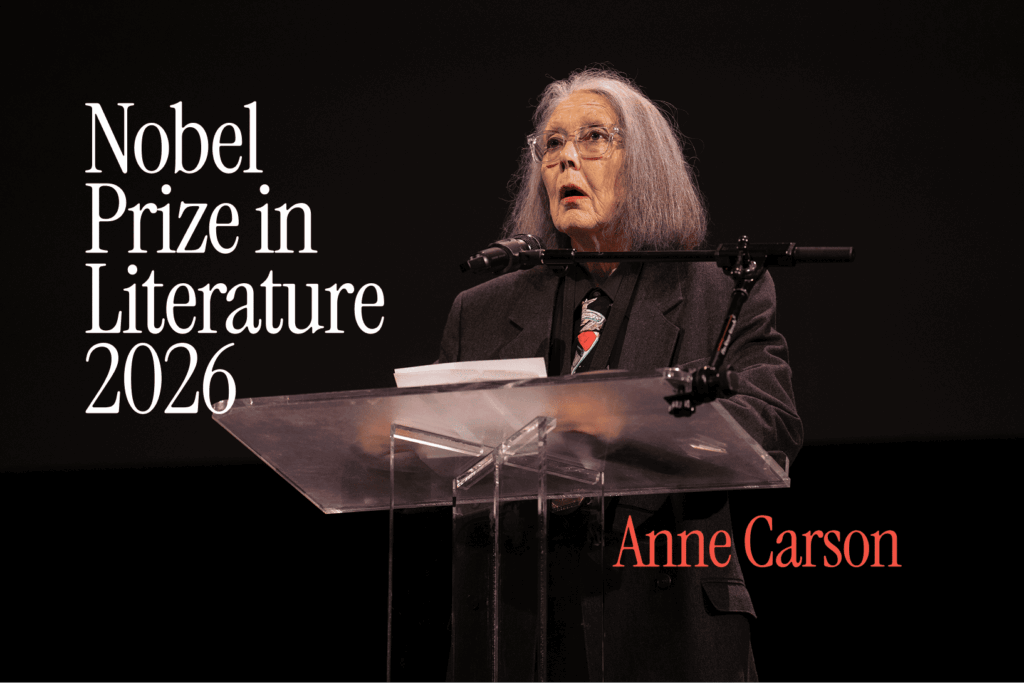
Canadian writer Anne Carson has won the 2026 Nobel Prize in Literature. The Swedish Academy announced the award in Stockholm on Thursday, October 8, honouring what it called her “bold and inventive oeuvre” and the way her playful conversation with the classical tradition has created new forms for contemporary literature. The prize is worth 12 million Swedish crowns, roughly US$1.2 million.
She is the first Canadian to win since Alice Munro in 2013, and the 19th woman among the 122 people who have received the literature prize. If her name is new to you, this guide covers who she is, what she writes, and where to begin.
BREAKING NEWS The 2026 #NobelPrize in Literature is awarded to the Canadian author Anne Carson, “for her bold and inventive oeuvre that, in playful dialogue with the classical tradition, has created new forms for contemporary literature.” https://t.co/YRvlRghlGG
— The Nobel Prize (@NobelPrize) October 8, 2026
Who Is Anne Carson?
Anne Carson was born in Toronto in 1950 and is 76 years old. She is a poet, essayist, translator, and classicist, and she has taught at universities including McGill, Princeton, NYU, the University of Michigan, and UC Berkeley. She also spends time in Iceland, where she holds citizenship. According to the Swedish Academy, she was in Iceland when the news arrived and was completely surprised by it.
Her path to the Nobel was a long one. She was the first woman to win the T.S. Eliot Prize, for The Beauty of the Husband in 2001. She has won the Griffin Poetry Prize twice, for Men in the Off Hours in 2001 and Red Doc> in 2013. She also received Spain’s Princess of Asturias Award for Literature in 2020 and the PEN/Nabokov Award in 2021. For years she was named among the leading candidates for the Nobel.
What Kind of Books Does She Write?
Carson is hard to shelve, and that is the point. Her books move between poetry, prose, essay, translation, and drama, and she often blends several in a single work. She has written verse novels, collections of very short “talks,” a book of poems about a marriage, and a grief book that arrives as a folded scrapbook in a box.
Her central influence is ancient Greek and Roman literature, but she does not treat it as a museum piece. She translates Sappho, Sophocles, and Euripides, and then uses those old stories to talk about desire, loss, memory, and family in a voice that feels modern, dry, and often funny. The Swedish Academy noted that her translations can be read as independent works in their own right.
The Books Behind the Prize
Eros the Bittersweet (1986)
An essay on desire in ancient Greek writing, built around the idea that love is both pleasure and pain. It is the earliest of her major books and a good window into how she thinks.
Autobiography of Red (1998)
A verse novel and her best-known book. It reimagines the myth of Geryon, a red, winged monster, as a sensitive modern boy who falls in love with Herakles. It is part coming-of-age story, part love story, part classical scholarship, and it reads far more easily than that description suggests.
The Beauty of the Husband (2001)
A long poem about the slow collapse of a marriage, told in a series of short numbered sections. It is intimate, sharp, and painful, and it won the T.S. Eliot Prize.
If Not, Winter (2002)
Her translation of the surviving fragments of the ancient Greek poet Sappho. Carson keeps the gaps and broken lines on the page, so you feel how much has been lost.
Nox (2010)
An elegy for her brother, who died abroad after years of estrangement. The book is a replica of a scrapbook, folded accordion-style in a box, combining photographs, letters, and a word-by-word translation of a Latin poem by Catullus. Nothing else reads like it.
Float (2016)
A collection of 22 separate chapbooks in a clear case that can be read in any order. It is the most experimental entry on this list.
Norma Jeane Baker of Troy (2019)
A work that compares Marilyn Monroe with Helen of Troy. It won the Governor General’s Award for English-language poetry.
Which Anne Carson Book Should You Read First?
Start with Autobiography of Red. It is her most celebrated book, it tells a story with a clear emotional arc, and it shows her whole range: myth, poetry, humour, and heartbreak. If it clicks, the rest of her work opens up.
| If you want | Start with | Format |
|---|---|---|
| The classic Carson experience | Autobiography of Red | Verse novel |
| Something emotional and unusual | Nox | Boxed, folded book |
| Ancient poetry in a new form | If Not, Winter | Translation |
| A study of desire and love | Eros the Bittersweet | Essay |
| Something experimental | Float | 22 chapbooks in a case |
Where to Find Anne Carson’s Books in Metro Vancouver
Expect demand to spike after a Nobel announcement, so your local library is a good first stop. The Vancouver Public Library Central Library and its neighbourhood branches carry her titles, though holds may take a while to fill this month.
For buying a copy, independent shops are worth a call before you go:
- Massy Books, an independent shop in Chinatown with a strong used and new selection
- Paper Hound, a downtown used bookstore
- People’s Co-op Bookstore, on Commercial Drive
- Book Warehouse, with several Vancouver locations
Stock will likely be tight for a few days, so check availability before heading out.
If this win has you in a reading mood, the 39th Vancouver Writers Fest runs October 18 to 25, 2026, on Granville Island and at other venues across the city, with more than 150 local and international authors in over 90 events. Check the festival program for poetry and translation sessions.
Frequently Asked Questions
Is Anne Carson Canadian?
Yes. She was born in Toronto and is widely regarded as one of Canada’s most important living writers. She also holds Icelandic citizenship and spends time there.
Is Anne Carson a poet or a novelist?
Both, and neither exactly. She is best known as a poet, but her “verse novels,” essays, translations, and performance pieces deliberately blur the lines between genres.
Do I need to know Greek mythology to read her?
No. Her books reward that knowledge, but the emotions at their centre, such as love, grief, and longing, are easy to follow without it.